

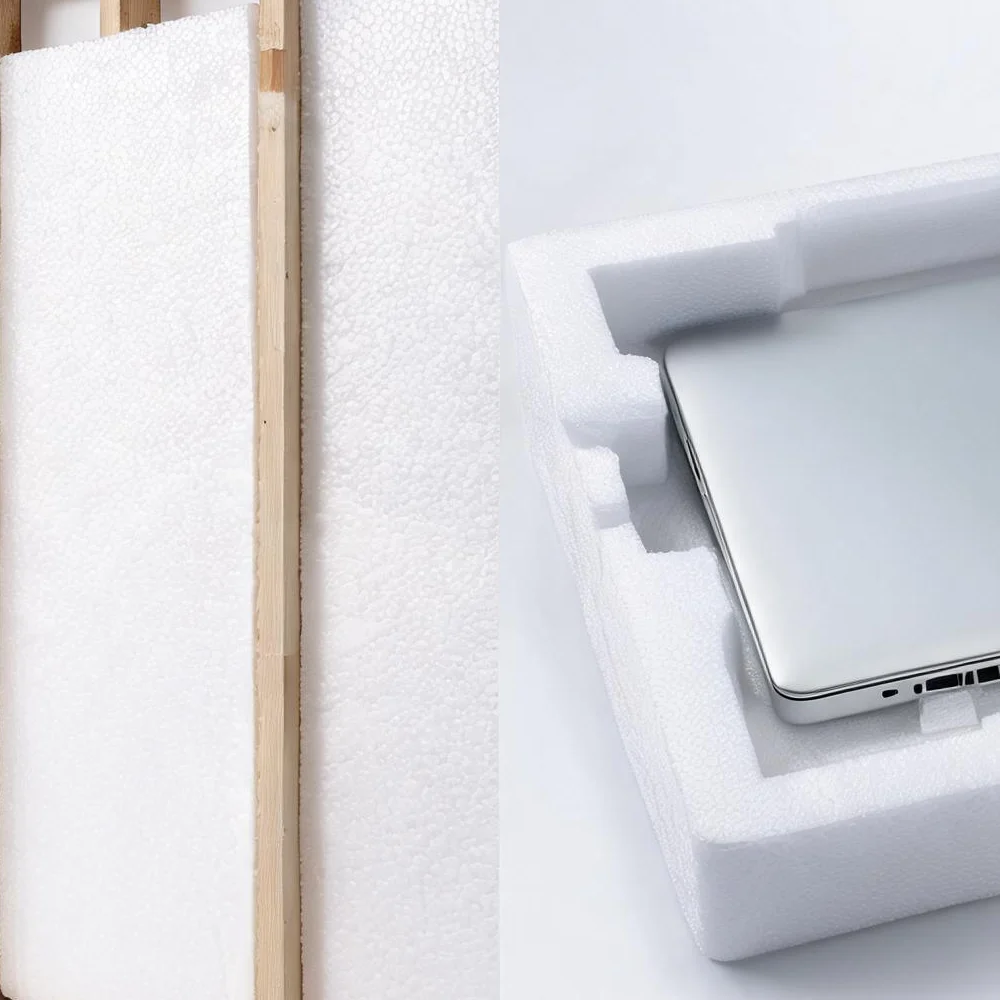
Specifying EPS insulation board usually starts with a target U-value and a thickness recommendation from a standard or an energy calculation. That is the correct starting point, but it is not the whole specification. Two boards of the same thickness can have materially different performance depending on density, and the right density is determined by the application, not by the thermal target.
Thickness is a thermal decision
Thermal resistance scales linearly with thickness. If a board of a given density delivers a specific R-value at 50 mm, the same board at 100 mm delivers approximately twice that, and the U-value of the assembly falls correspondingly. Increasing thickness is the most direct way to improve thermal performance, and in most projects it is the cheapest per unit of performance gained — right up to the point where the assembly's total build-up becomes a constraint.
That constraint is usually practical rather than thermal. Wall build-up affects window reveal depth, door frame positioning, and the fixing length required. Roof and floor applications are limited by available cavity depth and by the loads the assembly must carry. In retrofit work, the existing structure often sets the ceiling on thickness before the energy target does.
When thickness is capped by the build-up, the remaining lever is density — because higher-density EPS achieves slightly better thermal conductivity for the same thickness. That improvement is real but modest. Do not expect density alone to close a large thermal gap; if the assembly is significantly short of target, thickness and the overall detailing are where the answer lies.
Density is a structural decision
Density governs compressive strength. That is what determines whether the board can carry the loads the application imposes without deforming:
- Under-slab and floor applications — the board carries the slab and everything on it, permanently. This is the most structurally demanding common use, and it requires the higher end of the density range. Compressive strength at 10 per cent deformation is the property to specify and verify.
- External wall insulation — the board carries its own weight plus render and fixings, and must resist wind loading across the facade. Moderate density is usual, with the requirement rising on exposed elevations.
- Roof and terrace applications — load depends on whether the board is under a protective screed and whether the roof is accessible. Accessible roofs behave more like floors.
- Cavity and internal applications — where the board is protected and not load-bearing, lower density is adequate and reduces cost without compromising performance.
The mistake to avoid is selecting density from the thermal calculation. Thermal performance may be nearly identical across a range of densities, while load-bearing capacity varies substantially. The structural requirement should set the minimum density, and the thermal requirement should then set the thickness at that density.
Fire performance and the specification language that matters
Polystyrene is combustible. Flame-retardant grades reduce the rate at which fire spreads but do not make the material non-combustible, and the classification achieved depends on the specific formulation and on how the whole assembly performs in test — not on the board alone.
Two practical consequences follow. First, specify performance in terms of the classification standard that applies in your jurisdiction, rather than by describing the material as "fireproof" or "flame retardant," neither of which is a specification. Second, recognise that in most regulatory regimes the compliance of an external wall insulation system is assessed as a system — board, adhesive, render, and fixings together — and that the board's contribution is one input into that assessment. Ask your supplier for test documentation for the system, not only for the board.
Where the application carries an elevated fire requirement, the choice of insulation material itself may need to change rather than the grade within EPS. Graphite-modified polystyrene offers better fire behaviour and slightly better thermal performance than standard EPS, and mineral-based insulations are non-combustible. These are specification decisions to make early, because they affect thickness, weight, and fixing design across the whole assembly.
Moisture, dimensional stability, and the details that decide service life
EPS has low water absorption and, unusually among insulations, retains its thermal performance reasonably well when damp. That does not remove the need for a properly detailed assembly. Water that enters an insulating layer and cannot drain or dry will cause problems in the structure behind it regardless of the insulation's own tolerance for moisture.
Two aspects of the material's behaviour matter at installation:
- Dimensional stability. Freshly manufactured EPS continues to settle for a period after production. Boards installed while still curing can shrink slightly, opening joints. Suppliers should allow a curing period before dispatch, and site practice should avoid installing boards that have just come off the line. A curing interval of several days is normal for quality material.
- Joint treatment. Thermal performance of an insulation layer is lost at the joints, not in the field of the board. Tight-fitting boards with staggered joints and taped or sealed seams are what converts a good U-value calculation into a good U-value in service.
Storage on site matters for the same reasons covered in the production process — keep boards dry and out of direct sun, and do not leave them exposed to prolonged ultraviolet light, which degrades the surface.
Getting the specification onto the order
A specification that lives only in a drawing note will not survive translation into a purchase order. Put these on the order document explicitly:
- Density in kg/m³, with a stated tolerance band
- Compressive strength at 10 per cent deformation, if the application is load-bearing
- Thickness and dimensional tolerance, with the measuring surface defined
- Thermal conductivity value at the reference temperature used in your calculation
- Fire classification against the named standard applicable to your project
- Board dimensions and edge profile — square edge or rebated, since this affects joint performance
- Required curing period before dispatch
Then require the inspection records for your production batch to reference those same values. A specification that is written on the order but not measured in production is a document, not a control.
The selection sequence, in order
- Establish the target U-value and the available build-up depth.
- Determine the structural role of the board and set the minimum density from it.
- Confirm the fire requirement for the assembly, and whether it is met within EPS or requires a different material.
- Calculate the thickness required at the selected density.
- Check that the resulting build-up fits the structure and the fixing design.
- Write density, thickness, strength, conductivity, and classification onto the order with tolerances.
- Verify against batch inspection records on delivery.
Doing these in this order avoids the most common failure: selecting a board on thermal grounds and discovering at installation that it cannot carry the load it was specified to carry.